
 SPONSORED PARTNERMEXCExplore global spot and futures marketsEXPLORE MEXC →
 CHARTING PARTNERTradingViewAdvanced charts, indicators and market analysisOPEN CHARTS →
 TRADING PARTNERGMX via NetNapz TradeTrade decentralised perpetual marketsSTART TRADING →
Ethereum · Cryptography · 25 November 2026
Ethereum Researchers Choose Keccak-256 for Post-Quantum Design; Protocol Adoption Is Not Yet Approved
Ethereum Foundation researchers recommend Keccak-256 and related Keccak-f primitives for Ethereum’s planned hash-based cryptography. The publication defines a design direction, not an approved fork, activated signature scheme or guarantee against future attacks.
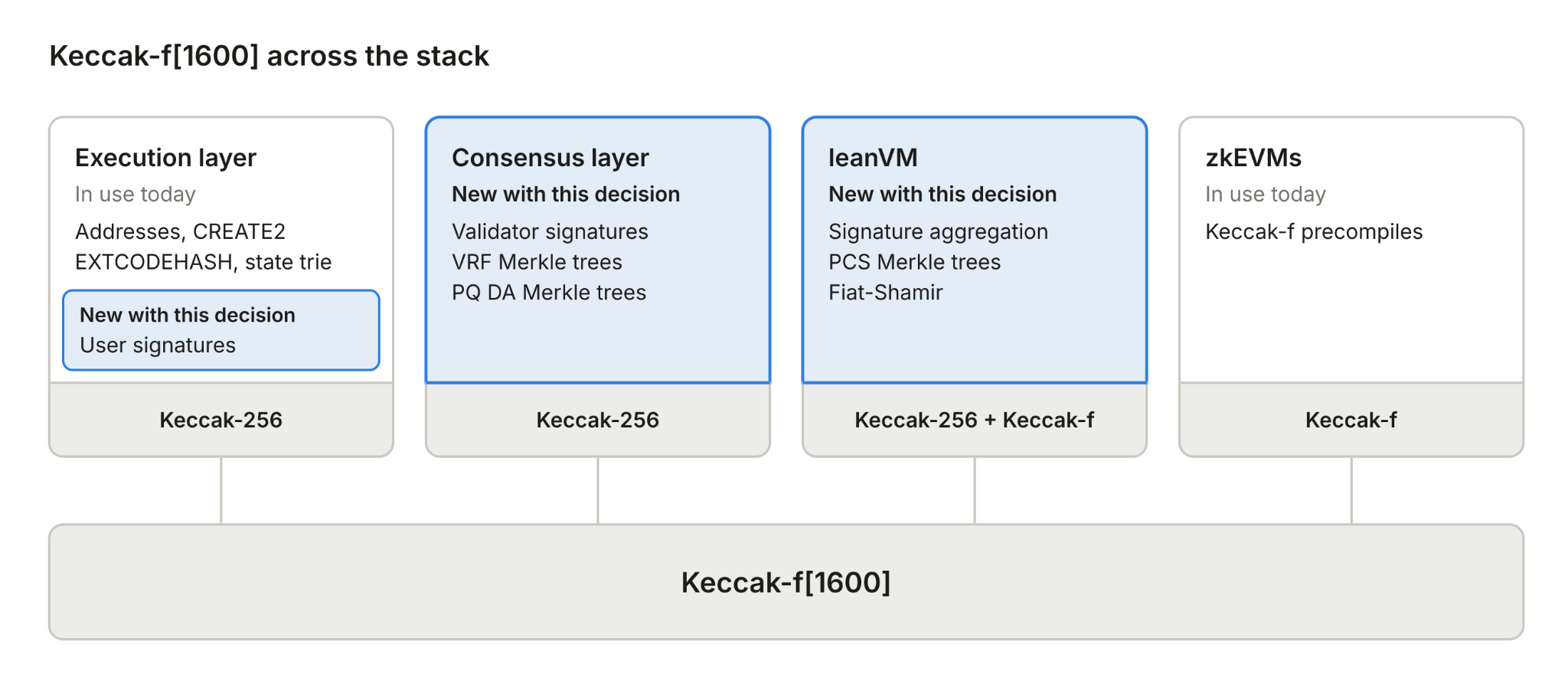
The Ethereum Foundation’s post-quantum and post-AI research programme has selected Keccak-256 as its recommended standard hash for Ethereum’s proposed hash-based cryptography. A 24 November technical paper says the wider construction would also use Keccak-duplex for Fiat–Shamir transformations and SHAKE256 for pseudorandom generation and key derivation.
The distinction between a research recommendation and a protocol change is central. The Foundation has not published a mainnet activation, an approved Ethereum Improvement Proposal, a complete client release set or a wallet migration procedure for this design. Ethereum currently uses elliptic-curve signatures in important parts of the protocol and ecosystem, so replacing them would require specifications, implementation, testing, audits and agreement across independent client teams and other stakeholders.
Why the researchers preferred Keccak
The Foundation’s technical comparison considered Poseidon and Poseidon2, BLAKE3, BLAKE2, SHA2-256 and Keccak-256. Its stated case for Keccak rests on a long public cryptanalysis record, a large remaining security margin and existing use within Ethereum. Keccak-256 already underpins Ethereum address derivation, execution-layer state and the KECCAK256 opcode.
The paper says proving performance no longer forces researchers toward hashes designed specifically for zero-knowledge systems. It reports that newer proving systems can process standard hashes quickly enough for the programme’s present aggregation target. That changes the trade-off: the team can prioritize established cryptanalysis and reuse of an existing Ethereum primitive, even though Keccak is slower than some alternatives in certain workloads.
The authors also distinguish Keccak-256 from the standardized SHA3-256 variant. Both use the same underlying permutation but different padding. They chose the Ethereum-native version to avoid introducing a near-duplicate primitive and the integration risks that would follow.
The broader migration remains early
A companion 23 November programme outline describes three workstreams: hash-based validator keys, wallet migration to hash-based signatures and hash-based commitments for blob data. It says early specifications and a consensus-layer development network are in progress. It also warns that wallet software, multisignature systems, staking pools, contracts and monitoring infrastructure would need changes.
The outline records December 2028 as a target proposed at Devcon, while describing 2029 as an internal deadline subject to review. In a 25 November Devcon recap, the Foundation described the ambition as completing the post-quantum and post-AI transition by late 2028, said leanVM had been formally verified end to end and scheduled a formal roadmap review for January 2027. The Foundation explicitly called the timeline a goal rather than a commitment. These are planning and research checkpoints, not confirmed fork dates; larger signatures, reworked BLS-dependent tooling and the need to keep node operation practical remain unresolved engineering constraints.
The 24 November paper gives one concrete client direction. Execution clients could reuse existing Keccak-256 implementations for signature verification. Consensus clients already use Keccak in discovery, but a future move of SSZ Merkleization away from SHA2-256 is framed as a recommendation. No client is instructed to change production consensus rules today.
What the announcement does not establish
The Foundation does not report that current Ethereum cryptography has been broken, that a quantum computer can attack Ethereum today or that artificial intelligence has compromised the protocol. Its argument is preventive risk management: choose conservative primitives and begin a difficult migration before the threat becomes immediate.
Nor does selecting a hash solve the entire migration. Signature constructions, key registries, wallet recovery, validator transitions, smart-contract compatibility, blob commitments, hardware requirements and formal verification still need detailed specifications and adversarial testing. The research paper compares primitives under stated assumptions; production security will depend on how the complete system is designed and implemented.
NetNapz assessment: the Keccak choice materially narrows one foundational design decision for Ethereum’s proposed post-quantum architecture. It does not authorize deployment. The next verifiable milestones are public specifications, development-network results, client implementations, security reviews and an explicit multi-client protocol process. Until those arrive, describing Ethereum as already post-quantum would be inaccurate.
Sources checked
- Ethereum Foundation: “PQAI #1” technical recommendation, published 24 November 2026.
- Ethereum Foundation: “PQAI #0” programme outline, published 23 November 2026.
- Ethereum Foundation: Devcon 8 India recap, published 25 November 2026, for the late-2028 goal, leanVM verification claim and January 2027 roadmap review.
- Ethereum Foundation website terms, checked 25 November 2026, for the CC BY 4.0 licence applying to unmarked non-code website content.