
 SPONSORED PARTNERMEXCExplore global spot and futures marketsEXPLORE MEXC →
 CHARTING PARTNERTradingViewAdvanced charts, indicators and market analysisOPEN CHARTS →
 TRADING PARTNERGMX via NetNapz TradeTrade decentralised perpetual marketsSTART TRADING →
Saudi Aramco Jazan Hit as Gulf Energy Risk Moves From Threat to Physical Attack
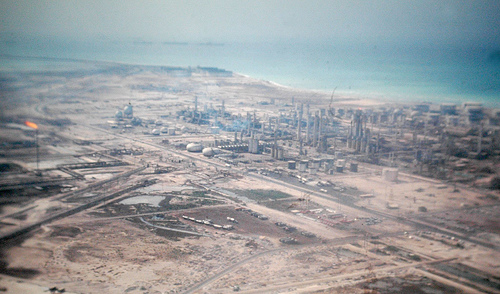
September 7, 2026 — NetNapz Market Desk: The Gulf energy-risk thesis has moved from warning to a fresh physical-infrastructure event. Saudi Aramco facilities at Jazan were hit again on Monday, according to the Financial Times citing people familiar with the matter, with damage still being assessed. Jazan’s refinery has about 400,000 barrels per day of processing capacity, according to Aramco’s own refinery footprint disclosures. The attack comes hours after Iran’s parliament speaker warned that U.S.-linked oil and gas infrastructure around the Gulf is exposed to reciprocal action, while Hormuz commodity traffic remains at its lowest level since May. Brent has pushed toward $100 as traders reprice the risk that maritime disruption and fixed-asset attacks begin reinforcing one another.
Mohsen Rezaei, secretary of Iran’s Supreme National Security Council, said in a televised interview carried by state-run Press TV that the planned zone would begin at the U.S. Navy’s blockade line and extend into parts of the Persian Gulf. He said vessels entering the designated area without coordination with Tehran would be placed on an Iranian sanctions list. The exact boundaries, enforcement mechanism and start date have not yet been published, so traders should treat this as a planned restriction rather than an already operational closure.
Associated Press independently reported the announcement and described it as another escalation following the latest U.S.-Iran exchange around oil tankers and naval assets. Iran has also made broader claims that the strait is effectively closed and under its control, but those assertions remain contested. The market-relevant distinction is therefore between a political declaration and evidence that commercial traffic, insurance availability or naval escort operations materially deteriorate.
Fresh development: Saudi Aramco Jazan facilities are hit again
The Financial Times reported on September 7 that Saudi Aramco oil facilities in Jazan were attacked again and that damage was being assessed, with one source describing the strike as similar in scale to the August incident. Aramco’s 2025 annual report lists Jazan as a 400,000-barrel-per-day refinery. The latest attack has not yet been followed by a detailed Saudi or Aramco damage statement, so NetNapz is treating the operational impact as unconfirmed rather than assuming a 400,000-bpd outage.
This is the important change in the market structure: the weekend thesis was about tanker attacks, restricted-zone threats and potential retaliation against energy infrastructure. Monday’s Jazan event introduces a new physical fixed-asset hit on the Red Sea side of Saudi Arabia, outside Hormuz itself. That matters because it broadens the risk map from one chokepoint to regional refining and export infrastructure. Brent traded above $98 in Monday trade, according to the Financial Times, bringing the $100 psychological level into immediate focus.
Why Jazan matters even before damage is known
Jazan is strategically important because it sits on Saudi Arabia’s Red Sea coast and can support product flows without relying on the Strait of Hormuz. A sustained outage there would therefore weaken one of the region’s diversification routes at the same time Hormuz traffic is already constrained. The bullish oil thesis strengthens if Saudi authorities confirm material damage, product exports remain halted, another fixed asset is struck, or refined-product cracks widen. It weakens if the facility remains operational, damage proves minor and maritime traffic begins to normalize.
Iran had already widened the threat to Gulf energy infrastructure
Iranian Parliament Speaker Mohammad Baqer Qalibaf said on September 7 that the region’s oil and gas production chain is broadly exposed and that U.S. oil and gas companies share that exposure, warning that further U.S. strikes on Iranian assets would draw reciprocal action. Anadolu Agency independently reported the warning, while Reuters documented the same remarks and the contemporaneous market reaction.
For traders, this is a more consequential escalation than another shipping-only threat because it broadens the potential target set from vessels and corridors to fixed energy infrastructure. The confirmation threshold is therefore higher: actual attacks, credible military warnings, operator shutdowns, insurance repricing or measurable export disruptions would turn rhetoric into a physical supply shock. Without those, the market may continue to price a risk premium without assuming sustained production loss.
Updated corridor maps and an Oman-linked framework
Later on September 7, independent reporting said Rezaei also indicated that Iran would publish updated maps for a shipping corridor and that Tehran envisages managing the route jointly with Oman. That gives traders a more concrete framework to monitor than the earlier restricted-zone headline alone: the next material signal is not just another warning, but an actual map, coordinates, traffic rules or enforcement notice.
Oman’s Foreign Ministry provides the strongest primary-source context for that claim. On August 25, Oman and Iran said they were discussing a phased framework for a joint temporary navigational corridor through the Strait, followed by technical negotiations over a permanent corridor, future administration, information-sharing and traffic management. Oman had already said in June that it was working with the International Maritime Organization on a temporary corridor for all vessels. Those official statements do not by themselves confirm Iran’s latest enforcement claims, but they show that the Oman-linked corridor concept is real and predates today’s escalation.
For traders, that narrows the confirmation test. If new coordinates are published and Oman, the IMO or shipping operators acknowledge them, the story shifts from political signaling toward an operational maritime regime. If Tehran publishes unilateral restrictions that Oman or international shipping bodies do not recognize, the risk premium may remain high but the economic impact will depend more heavily on actual compliance, escorts, insurance and vessel diversions.
Why this is a stronger oil catalyst than another headline threat
The Strait of Hormuz is one of the world’s most important energy chokepoints. A new restricted zone matters because even partial uncertainty around vessel access can increase freight rates, war-risk insurance premiums, voyage delays and the probability that buyers seek alternative barrels. That can tighten effective supply even if producing countries do not formally cut output.
The timing raises the stakes. OPEC+ decided on September 6 to hold October required production at September levels, removing the possibility of another scheduled increase just as Gulf shipping conditions are becoming less predictable. That combination does not automatically mean crude must surge, but it increases the market’s sensitivity to verified physical disruption.
The trader question: declaration or enforceable disruption?
For NetNapz, the key analytical test is whether the proposed zone changes actual flows. Iran can announce sanctions or restrictions, but the cross-asset impact depends on what shipowners, insurers, naval escorts and cargo buyers do next.
Recent vessel-tracking data already point to unusually weak Hormuz traffic. Reuters, citing Kpler, reported that commodity-ship transits over the latest 10-day period fell to their lowest level since May, averaging roughly 10 ships per day. That is important context, but it should not be conflated with Iran’s separate claim that the strait is completely closed. The stronger evidence is that traffic has become materially thinner and riskier, not that all transit has stopped.
Cross-asset consequences
Oil and refined products
Brent is the first market to watch when futures liquidity returns. A sustained move through the recent mid-$90s area, especially if accompanied by lower tanker traffic or higher freight costs, would strengthen the supply-risk thesis and put $100 back into focus. A failure to hold the low-to-mid-$90s despite the announcement would signal that traders see the restricted-zone threat as difficult to enforce or already priced.
Treasury yields and the U.S. dollar
The macro transmission runs through inflation expectations. Friday’s strong U.S. payroll report already pushed yields and the dollar higher. If oil adds another leg up, markets could price a stickier inflation path and a more restrictive Fed backdrop. That would be a headwind for duration-sensitive assets and global dollar liquidity.
Nasdaq 100, Nvidia and high-duration equities
AI and technology stocks are indirectly exposed through rates. The important confirmation is not simply whether crude rallies, but whether higher oil is accompanied by firmer Treasury yields. If yields rise with oil, valuation pressure on the Nasdaq 100 and Nvidia-style long-duration growth becomes more credible. If oil rises while yields fade, the cross-asset tightening signal is less clean.
Bitcoin, Ethereum and altcoins
Crypto remains the only major risk market trading continuously through the weekend transition. Bitcoin’s response can therefore provide an early read on whether traders interpret the news as a global-liquidity shock or a contained geopolitical event. A stronger dollar and rising yields would normally pressure BTC, ETH and high-beta altcoins. Relative resilience despite those conditions would be a constructive signal for crypto-specific momentum.
NetNapz assessment
Bias: bullish oil-risk premium / cautious broad risk, with the evidence threshold now higher. The Jazan attack is the first fresh fixed-energy-infrastructure event in this September 7 sequence, so the thesis is no longer purely about threats and shipping rules. But the size of the operational impact is still unconfirmed. NetNapz would not equate a hit on a 400,000-bpd refinery with a 400,000-bpd outage unless Saudi or Aramco data confirm that loss.
The thesis strengthens if Saudi authorities confirm material downtime, refined-product exports tighten, another regional energy asset is struck, Hormuz traffic deteriorates further or Brent establishes above $100 alongside firmer inflation expectations and yields. It weakens if Jazan damage proves limited, product flows normalize, Hormuz transits recover and Brent falls back through the low-to-mid-$90s.
What to watch next
1. Formal zone boundaries and effective date
The most important next document is the actual notice defining where the restricted zone begins, what vessels are covered and how Iran says it will enforce sanctions or passage rules.
2. U.S. and regional-government response
A formal CENTCOM, U.S. Navy, Omani or Gulf-state response could determine whether shipping companies view the announcement as operationally meaningful. Any escort expansion or navigation warning would raise the signal quality.
3. Tanker and cargo traffic
Actual transits are the cleanest confirmation. Falling ship counts, VLCC delays, rerouting or widening insurance premiums would show the geopolitical story becoming a physical supply story.
4. Brent around the mid-$90s
A sustained break higher with physical-flow confirmation would strengthen the path toward $100. A retreat into the low-$90s despite the announcement would be an early invalidation of the immediate escalation trade.
5. Dollar, yields and Bitcoin together
If crude, DXY and Treasury yields rise while Bitcoin weakens, the market is treating the development as an inflationary liquidity shock. If BTC holds up and yields fail to follow oil, the broader tightening impulse is weaker.
Broader market context
The new announcement arrives less than a day after OPEC+ opted to keep October output policy steady. That makes physical shipping conditions more important than nominal quotas. Traders should separate announced production capacity from barrels that can actually reach buyers: port access, tanker availability, naval security, sanctions and insurance can all dominate headline supply numbers during a maritime conflict.
It also creates a more complicated policy setup for central banks. A shipping-driven oil shock would be negative for growth but potentially positive for near-term inflation, leaving policymakers with less room to respond to weakening risk assets. That is why the Hormuz story can move far beyond energy futures into rates, FX, equities and crypto.
Bottom line
September 7 has now produced a physical fixed-asset escalation, not just another threat: Saudi Aramco facilities at Jazan were hit again while Hormuz traffic is already unusually thin and Brent is pressing toward $100. The trader test is operational confirmation. Material Jazan downtime, another regional energy strike or further deterioration in tanker flows would strengthen the inflation-and-liquidity shock; limited damage and improving traffic would weaken it.
Sources
Financial Times — Saudi Aramco oil facilities hit in new strikes, September 7, 2026
Saudi Aramco — 2025 annual report, refinery footprint and Jazan capacity
Wikimedia Commons — Ras Tanura refinery image, public domain
Reuters — Iran warns U.S.-linked Gulf energy assets are exposed to retaliation, September 7, 2026
Anadolu Agency via Yeni Şafak — Qalibaf warns U.S. Gulf energy assets are exposed, September 7, 2026
Wikimedia Commons — Mabot oil platform, U.S. Navy public-domain image
Press TV — Iran to declare new restricted zone outside Strait of Hormuz, September 6, 2026
Associated Press — Iran says it plans to announce a new exclusion zone near the Strait of Hormuz, September 7, 2026
Reuters — Hormuz traffic falls to lowest level since May, citing Kpler, September 6, 2026
Oman Foreign Ministry — Joint Oman-Iran statement on temporary and permanent navigational corridors, August 25, 2026
Oman Foreign Ministry — Oman/IMO temporary Hormuz corridor framework, June 24, 2026
Reuters — Iran says updated corridor maps and a new restricted zone are coming, September 7, 2026


Risk disclaimer: This article is for informational purposes only and is not financial advice. Geopolitical headlines can change quickly and may be disputed or revised. Verify live prices, official navigation notices and primary-source statements before trading.